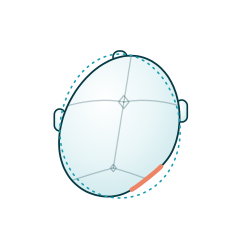
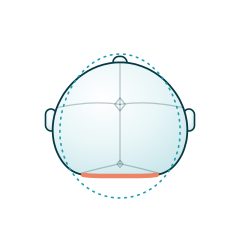
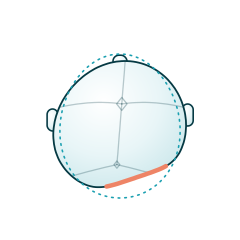
Dolichocephaly
Dolichocephaly is when the head looks long and narrow. It is especially common in premature babies who spend long periods lying on their side. With early diagnosis and a cranial orthosis, it largely improves.
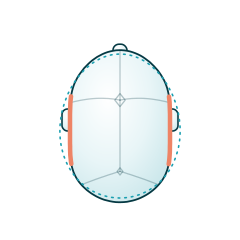
- Normal head contour
- Flattened area
On this page
Have you noticed these?
Signs
If you notice any of these signs, consult a specialist.
- Front-to-back length of the head longer than normal
- Narrow side-to-side width of the head
- Oval / elongated appearance when viewed from the side
- Prolonged side-lying (especially in premature babies)
What Is Dolichocephaly?
Dolichocephaly is a condition in which the head is long and narrow. The term "dolichocephaly" comes from Ancient Greek and combines "dolichos", meaning "long", and "kephale", meaning "head". The condition is generally considered a congenital malformation that leads to skull shape deformities. Dolichocephaly can arise for various reasons, such as infection, genetic factors or environmental influences. The answer to the question "what is dolichocephaly?" is often linked to premature birth. Premature babies who spend long periods lying on their side can develop a distorted head shape. Dolichocephaly is also associated with certain genetic syndromes. For example, it can be seen together with conditions such as Sotos syndrome, Marfan syndrome and Crouzon syndrome. If it is not diagnosed and treated in time, the condition can affect quality of life. It is therefore important for children with skull shape deformities to have regular check-ups and assessments from an early age. The shape of the head should be observed carefully from the very first days, and a specialist doctor should be consulted if necessary. Interventions to correct the length and narrow areas of the skull are part of dolichocephaly treatment.
What Are the Symptoms of Dolichocephaly?
Dolichocephaly is a condition in which the head is longer and narrower than expected. It is usually noticed in infancy or early childhood. The most common symptoms of dolichocephaly are: • Head Shape: The front-to-back length of the head gradually increases, while the sides take on a narrow appearance. This altered shape creates a noticeable difference in the baby's appearance. • Growth and Development Problems: In some cases, children with dolichocephaly may experience developmental delays compared with their peers. These delays may show up in motor skills and speech. • Neurological Symptoms: In some children, dolichocephaly can cause headaches or seizures. Such symptoms may be related to pressure inside the head. • Facial Changes: Dolichocephaly is not limited to head shape; it can also change the structure of the face, making the face look longer. These symptoms are mostly noticed in infancy. With the necessary treatment and regular follow-up, dolichocephaly can be managed. Dolichocephaly treatment generally relies on early diagnosis and includes interventions aimed at correcting the head shape. If it is not treated by the age of five, it can have lasting effects. The development of children diagnosed with dolichocephaly should therefore be monitored closely.
Causes of Dolichocephaly
Dolichocephaly is a condition that usually results from abnormalities in head structure. First of all, its causes include genetic factors, environmental influences and trauma during birth. In answering the question "what is dolichocephaly?", the following factors related to head length are highlighted: • Genetic Predisposition: A family history of dolichocephaly or other skull shape deformities can increase a child's risk. Conditions such as diabetes, heart disease and certain genetic syndromes in particular may increase the likelihood of dolichocephaly. • Premature Birth: Babies born prematurely may be more prone to dolichocephaly. In these babies, brain development after birth may not progress as expected and deformities of the head shape may be seen. • Lying Position: Newborn babies in particular who always lie in the same position can develop head shape deformities. Lying for long periods on the side or on a flat surface creates pressure on one part of the head and can cause deformities such as dolichocephaly. • Complications of Skull Surgery: Dolichocephaly can sometimes be associated with complications after brain surgery. Following surgical interventions, head growth may be restricted or take an incorrect shape. • Neck Muscle Development: Weakness or abnormalities in the neck muscles can cause the head to stay fixed in a certain position, increasing the risk of dolichocephaly. • Environmental Effects: Certain environmental factors that expectant mothers are exposed to during pregnancy, such as medications or chemicals, can adversely affect brain and skull development. These factors are only some of the causes underlying dolichocephaly. The treatment and management of dolichocephaly are determined by specialist physicians according to the underlying causes. Regular follow-up and appropriate treatment are very important for the healthy development of a baby diagnosed with dolichocephaly.
Treatment and Management of Dolichocephaly
Dolichocephaly treatment generally varies depending on the underlying causes. First and foremost, early diagnosis is very important for the treatment process to be as effective as possible. If the abnormality in the baby's head shape is noticed early on, treatment methods can produce more successful results. The main methods used in treating dolichocephaly are described below: In the early stages, treatment of dolichocephaly usually begins with non-invasive methods. For example, a Cranioplus helmet can help correct the baby's head shape. The Cranioplus helmet distributes pressure around the baby's head correctly, allowing the desired shape to be achieved. If the symptoms of dolichocephaly have become more severe or are combined with other health problems, surgery may be required. Surgical treatment is performed to correct the structures of the skull, and a detailed assessment is carried out by a specialist pediatric neurosurgeon during this process. In summary, dolichocephaly can be managed in various ways depending on the severity of the symptoms and individual needs. For this reason, coordinated monitoring and intervention together with a specialist physician are important for both physical recovery and psychological support.
What Is Dolichocephaly?
Dolichocephaly is a condition in which the skull is longer and narrower than normal. It is generally defined as a disruption of the ratio between the width and the length of the head. Dolichocephaly can arise from genetic factors or environmental influences and is sometimes also referred to as scaphocephaly. It is observed more often in situations such as premature birth.
What Are the Symptoms of Dolichocephaly?
Symptoms of dolichocephaly may include abnormal head length, asymmetry of the head shape, swelling of the head and developmental delays. Abnormalities in physical development and, in some cases, neurological problems may also be observed in children. These symptoms should be carefully evaluated and monitored before a diagnosis of dolichocephaly is made.