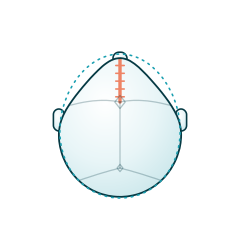
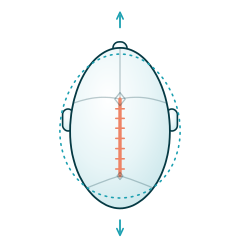
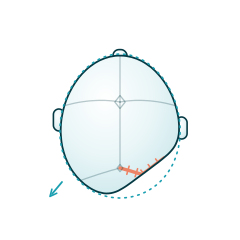
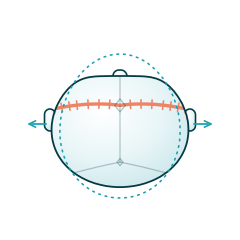
Coronal Suture Synostosis (Anterior Plagiocephaly)
An asymmetrical head shape caused by premature closure of the coronal suture: the forehead flattens on one side and bulges on the other.
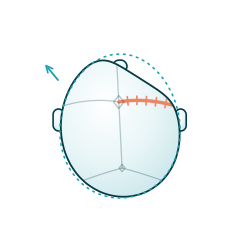
- Normal head contour
- Prematurely fused suture
- Compensatory growth
Have you noticed these?
Signs
If you notice any of these signs, consult a specialist.
- Asymmetrical forehead, uneven eye level, deviation of the nasal root, difference in ear position, chin asymmetry, irregular head circumference growth
What Is Coronal Suture Synostosis (Anterior Plagiocephaly)?
Anterior plagiocephaly is a head shape disorder seen in newborn babies. It occurs when the coronal suture, one of the seams between the skull bones, closes prematurely. Normally, the sutures between the bones that form the skull do not fuse together, so that the skull stays flexible while the baby's brain develops. However, early closure of the coronal suture makes the skull grow asymmetrically, and this is called anterior plagiocephaly.
Anterior plagiocephaly usually affects only one side. It causes the forehead and brow on the affected side to flatten, while the forehead on the opposite side appears noticeably prominent. The condition can also affect the symmetry of the baby's face. Although anterior plagiocephaly is usually noticed at birth or shortly afterwards, it is sometimes detected later, once it has progressed during development.
In addition to the skull deformity, anterior plagiocephaly can affect brain development and may therefore have an impact on the child's overall health.
Symptoms
- Asymmetrical Head Shape: One side of the head flattens while the other side bulges more noticeably; this is especially evident at the front (the forehead).
- Forehead Asymmetry: The asymmetrical shape of the forehead can create a difference in the level of the baby's eyes.
- Uneven Eye Sockets: One eye may sit higher or lower than the other.
- Nasal Changes: The root of the nose may appear shifted to one side.
- Ear Position: Differences in size and position between the right and left ears.
- Chin Changes: The chin may be shifted to one side.
- Head Circumference Growth: Normal growth may slow down or become irregular.
Treatment Approach
Treatment varies according to the severity of the condition and the baby's age.
Surgical Intervention: Used particularly in severe cases. The most common method is endoscopic craniosynostosis surgery. In this procedure, a closed technique is used to correct the skull shape through a few small incisions. After endoscopic surgery, helmet therapy is essential to protect the brain tissue and support its development.
Helmet Therapy: Wearing a specially designed helmet after surgery is an important part of the treatment process.
Age Range
The condition is usually noticed at birth or shortly afterwards. Treatment started at an early age in particular contributes to more successful outcomes.