Do Baby Head-Shaping Pillows Work? Are They Safe?
Do baby head-shaping and flat head pillows prevent or correct a flat head, and are they safe for sleep? Safe sleep advice and what to do instead.
Baby head-shaping pillows (often sold as flat head pillows or head correction pillows) are not recommended for sleep. The American Academy of Pediatrics (AAP) advises placing babies on their back on a firm, flat surface with no pillows or soft items, and there is insufficient evidence that these pillows prevent or correct a flat head. If you are worried about your baby’s head shape, a check-up with your pediatrician or an experienced specialist is a safer first step than buying a pillow.
What is a baby head-shaping pillow?
These products are usually soft pillows with a hollow centre, a ring shape or a contoured design meant to hold the baby’s head in a certain position. They may be made of foam, gel or memory foam. Most claim to spread pressure on the back of the head to prevent flattening or reduce an existing flat spot. These claims are not well supported by scientific evidence.
Are flat head pillows safe for sleep?
No, they are not considered safe for sleep. According to AAP safe sleep guidance, babies should sleep on their back for every sleep during the first year, and the sleep space should be free of pillows, blankets, bumpers, toys and positioners. Soft surfaces can lead to rebreathing and suffocation. The U.S. Food and Drug Administration (FDA) has also issued general warnings against infant sleep positioners and similar products. These risks outweigh any possible benefit for head shape.
Can a pillow fix a flat head?
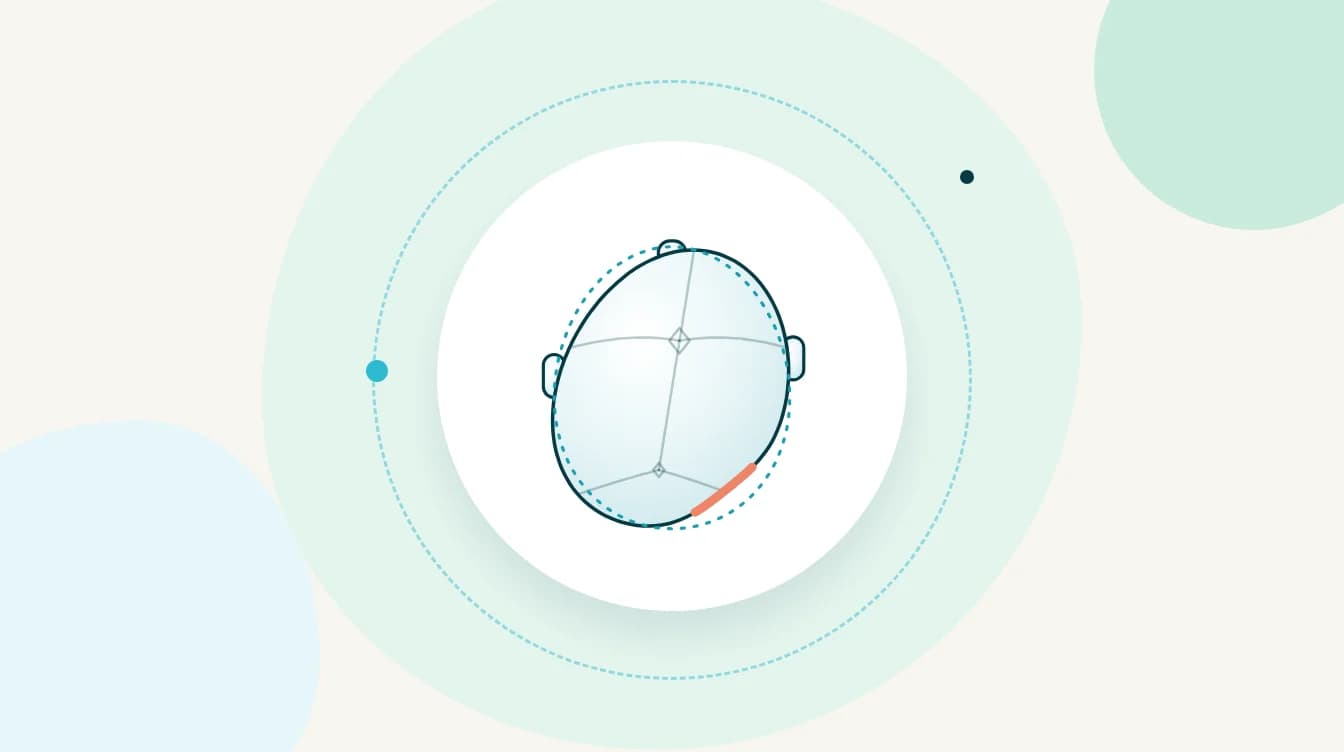
There is no strong, reliable evidence that pillows prevent or correct plagiocephaly (flattening on one side of the head). Head shape depends on where the growing skull has room to expand. If a baby rests on the same spot for hours, growth in that area can stay restricted even on a softer surface. That is why guidelines focus on varied positioning, tummy time and timely assessment instead of pillows.
What can parents miss when relying on a pillow?
- Safe sleep: A pillow adds a soft item to the sleep space.
- The underlying cause: A baby who always turns to one side may have torticollis, which needs assessment and sometimes physiotherapy.
- Timing: The skull grows fastest in the first months. Weeks spent waiting for a pillow to work can delay a useful assessment.
- Correct diagnosis: Rarely, an unusual head shape is caused by early fusion of skull sutures (craniosynostosis), which no home product can change.
What should I do instead of using a pillow?
- Alternate head direction: Always place your baby on the back, but alternate the side the head faces from one sleep to the next.
- Change the cot orientation: Place light, the door and your position on the side your baby looks at less.
- Tummy time: Offer supervised tummy time while awake, starting with short sessions. See our tummy time guide.
- Hold your baby upright: Carrying reduces pressure on the back of the head; switch arms during feeds.
- Limit equipment time: Keep time in car seats, bouncers, swings and strollers to what is needed.
For more on safe positions, read how to position your baby for a good head shape.
Does a flat head improve on its own?
Mild flattening often improves noticeably over months when it is spotted early and repositioning is practised consistently. As babies gain head control, roll and sit, pressure on the flat area decreases. Moderate and severe flattening is less likely to resolve fully on its own. We cover this in does plagiocephaly go away on its own.
When is a helmet considered?
When flattening is moderate to severe, or does not improve enough despite repositioning, a custom cranial orthosis (baby helmet) may be discussed after a specialist assessment. Unlike a pillow, a helmet does not add soft items to the sleep space; it is made for the individual baby and leaves room for growth in flattened areas. The decision is usually made at around 4–6 months, based on measurements and age. See baby helmet therapy and deformational plagiocephaly.
When should you see a specialist?
- A flat spot at the back or side that becomes more noticeable over a few weeks
- Ears or forehead that do not line up when viewed from above
- Your baby always turns to one side or struggles to turn the other way
- No improvement after a few weeks of repositioning
- A pointed, triangular or ridged head shape
You can book an appointment for a head shape assessment and discuss the right approach for your baby.
Frequently asked questions
Are baby head-shaping pillows harmful?
Used during sleep, they add a soft surface that can increase the risk of suffocation and sudden infant death syndrome (SIDS), so they are not recommended.
Will a flat head pillow correct my baby’s head shape?
There is not enough evidence that it will. Repositioning and tummy time are recommended for mild flattening, and more noticeable cases need assessment.
Can I use a head pillow while my baby is awake?
Short, fully supervised use while awake does not carry the same sleep risks, but its effect on head shape is unclear. Remove it if your baby falls asleep.
What if my baby’s head always falls to one side?
This can be a sign of torticollis. Talk to your pediatrician; physiotherapy may be recommended and head shape can be monitored.
When can a baby use a pillow?
Pillows are not recommended in the sleep space during the first year. The right time later depends on your child’s development, so ask your pediatrician.