Baby Helmet Therapy: Why Do Babies Wear Helmets?
What a cranial helmet is, when it is needed, the usual starting age, how treatment works, daily wearing time and how it differs from a protective helmet.
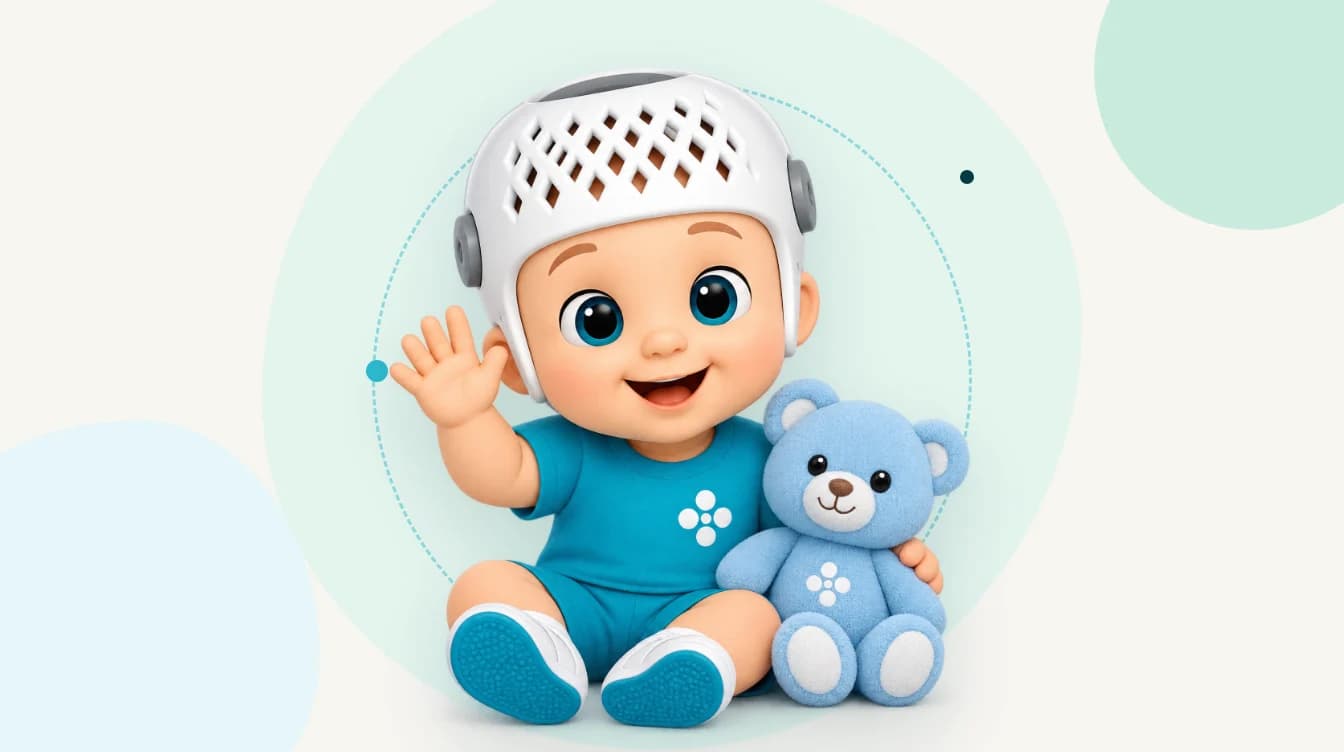
Baby helmet therapy means using a custom-made cranial orthosis (a head-shaping helmet) to guide the growing skull towards flattened areas in babies with a marked flat spot or head asymmetry. The helmet is usually worn 22–23 hours a day, and treatment usually lasts between 3 months and 1 year. Whether a helmet is needed is decided by a specialist after assessing the baby's age, the degree of flattening and the examination findings.
What is a baby head helmet?
The device parents call a "baby helmet" or "head-shaping helmet" is medically known as a cranial orthosis. It has a light, rigid outer shell and a soft inner lining that touches the baby's skin. It is not an off-the-shelf product: each helmet is designed and made to fit one baby's head.
A cranial helmet does not squeeze the head into shape. It makes contact over the more prominent areas and leaves space over the flattened areas. As the skull keeps growing naturally, growth is directed into that space. This is why the effect is greatest in the first months, when the skull grows fastest.
Why do babies wear helmets?
A newborn's skull is soft and the seams between the bones (sutures) are open. This allows the brain to grow quickly, but it also means the head can be shaped by outside pressure. When a baby lies on the same spot for long periods, that area can become flat.
In most babies who wear a helmet, the cause is a positional (deformational) head shape condition. Factors that make flattening more likely include:
- Always turning the head to the same side
- Tight neck muscles (torticollis)
- Prematurity, multiple pregnancy or a cramped position in the womb
- Long periods in car seats, bouncers and strollers
- Little supervised tummy time while awake
The American Academy of Pediatrics (AAP) recommends placing babies on their back for every sleep. Back sleeping remains essential; flattening is prevented by varying the baby's position while awake and alternating the direction the head faces. Many mild cases improve with these measures, as explained in our article does plagiocephaly correct itself. Helmet therapy is usually considered for moderate or marked flattening, or when repositioning has not helped enough.
When is a helmet needed?
- Deformational plagiocephaly: flattening on one side of the back of the head. Seen from above, the head may look like a parallelogram, with the ear and forehead on that side shifted forward.
- Deformational brachycephaly: flattening across the whole back of the head, making it look short and wide.
- Dolichocephaly: a long, narrow head, more often seen in premature babies who spent long periods lying on their side.
Craniosynostosis is different: one or more skull sutures close too early, and diagnosis and treatment are planned by a neurosurgical team. A helmet does not replace surgery, but after certain surgical techniques it may be used for post-operative shaping as part of the surgeon's plan.
At what age does helmet therapy start?
Mild cases are usually managed first with repositioning, tummy time and, if needed, physiotherapy. For babies with moderate or marked asymmetry, or no adequate improvement, a helmet is usually considered at around 4–6 months. Treatment can start later, but as skull growth slows the expected change is more limited and treatment may take longer. The decision is based on examination and measurements.
How is helmet therapy done?
- Assessment: history, head shape, neck movement and the type and degree of flattening are reviewed. If craniosynostosis is suspected, the baby is referred to the relevant doctor.
- 3D optical scan: the head shape is recorded with a radiation-free, contact-free optical scan. Read more in what is a 3D head scan.
- Custom design and manufacture: the helmet is designed from the scan to leave room for growth over the flattened areas.
- Fitting: the fit is checked and parents learn how to put it on, clean it and check the skin. Wearing time is built up gradually over the first days.
- Follow-up visits: the inner surface is adjusted as the baby grows, and repeated measurements track progress objectively.
How many hours a day and for how many months?
The helmet is usually worn 22–23 hours a day, including night sleep and naps, and removed for about an hour for bathing, skin care and cleaning. Total duration varies, and it is usually between 3 months and 1 year. It depends on starting age, severity, consistent wear, growth rate and conditions such as torticollis. The end of treatment is decided from follow-up measurements. See how long is a cranial helmet worn.
Is helmet therapy harmful?
A well-fitted helmet that is followed up regularly is generally well tolerated, and most babies adapt within a few days. The helmet guides skull growth rather than restricting it. Points to watch:
- Sweating: common in the first weeks; dress the baby lightly and keep the room cool.
- Skin redness: light pink marks usually fade soon after removal. Persistent redness, sores or blisters should be reported to the treating team before the helmet goes back on.
- Odour: reduced by cleaning the helmet and the baby's hair daily.
Safe-sleep rules do not change with a helmet: always on the back, on a firm flat surface, without pillows or soft items. See cranial helmet care.
Is a cranial helmet the same as a protective baby helmet?
No. Some parents searching for a "baby helmet" are looking for a soft protective helmet for crawling and first steps. A cranial orthosis is a custom medical device made after specialist assessment to help improve head shape. A protective helmet is an off-the-shelf impact-protection product; it does not reshape the head. Cranioplus provides cranial orthosis treatment only and does not sell protective helmets.
Who provides helmet therapy?
The process usually starts with the paediatrician noticing a head shape difference. When needed, the baby is referred to a paediatric neurosurgeon or other specialists, and conditions such as craniosynostosis are ruled out. Scanning, design, fitting and follow-up of the orthosis are carried out by orthotic centres in line with the doctor's assessment.
What happens after treatment?
When follow-up measurements show the goals have been reached, or further growth is unlikely to bring meaningful change, the helmet is stopped. Head shape continues to be followed as the child grows; hair growth often makes small differences less visible. If torticollis is present, exercises and physiotherapy should continue. Results differ for every baby, so expectations should be discussed openly during assessment.
When should you see a specialist?
- A flat spot that does not improve within a few weeks
- Ears or forehead visibly out of line when viewed from above
- A baby who always turns the head to one side
- A head that looks very long and narrow, or short and wide
- A hard ridge along the skull, or concerns about the soft spot
Early assessment clarifies whether a helmet is needed and, if so, allows treatment at a suitable time. You can book an appointment for an assessment.
Frequently asked questions
Does a baby helmet hurt?
A properly made and well-fitted helmet does not squeeze the head and usually does not cause pain. Contact the treating team if you notice persistent redness or discomfort.
Does every baby with a flat head need a helmet?
No. Many mild cases are managed with repositioning, tummy time and physiotherapy if needed.
Can my baby sleep in the helmet?
Yes. The helmet is worn during sleep, always with the baby on the back on a firm, flat surface, without heavy clothing or blankets.
At what age does helmet therapy usually start?
It is usually considered at around 4–6 months for moderate or marked asymmetry, though it can start later with more limited expected change.
Can babies in helmets carry on with daily life?
Yes. They can play, do tummy time, crawl and follow their usual routines.
Can a helmet replace surgery for craniosynostosis?
No. Craniosynostosis is managed by a neurosurgical team; a helmet may only be used after some operations as part of the surgical plan.